If you are wondering why a Mesa HVAC company outranks you in the map pack, the answer typically comes down to three things: a more complete google business profile, tighter citation consistency, and stronger review velocity. These are the signals Google weighs for local search placement, and they are exactly what our local SEO services are built to address.
By Brotherly SEO Team
Understanding Why a Mesa HVAC Company Outranks You in the Map Pack
The map pack is the three-business block that appears in google search results above organic listings when someone searches with local intent. For hvac companies in Mesa, that means queries like "AC repair Mesa AZ" or "emergency HVAC near me" trigger the pack. Google determines who fills those three spots using three categories: relevance, distance, and prominence.
Relevance measures how closely your business profile matches what the searcher is asking for. Distance accounts for proximity to the searcher or the city named in the query. Prominence is the hardest to earn and the most decisive in competitive markets. It draws from your review count, review ratings, citation authority, website strength, and overall activity on your google business profile.
HVAC contractors face a particularly competitive local search environment because the service is high-intent and seasonal. When someone's air conditioner fails in July, they search, click one of the first three results in the map pack, and call. The map pack is not just a visibility feature; for hvac companies it is a direct revenue channel, and ranking in it consistently is the difference between a phone that rings and one that does not.
Google Business Profile Optimization: What the Leaders Do Differently
Google business profile optimization is the single highest-leverage task for map pack visibility. Most hvac contractors claim their listing, add a phone number and address, and move on. The companies holding the top positions in the pack treat the profile as a live asset they maintain consistently.
Primary and Secondary Business Categories
Your primary category should be "HVAC Contractor" or "Air Conditioning Contractor," not a generic trade category. Adding accurate secondary categories (heating contractor, furnace repair service, air duct cleaning service) extends your profile's relevance to more query types. A competitor with three well-chosen categories shows up in searches that you are simply invisible for.
Service Areas
Google lets you define your service areas by city, ZIP code, or county. If you serve Chandler, Gilbert, and Tempe but have not added those cities to your profile, you do not appear in local search results for those locations. An HVAC competitor that has fully built out their service areas will outrank you in those cities even if your shop is geographically closer to the searcher.
Profile Completeness and Freshness
Photos from real jobs, posted updates, detailed service listings, populated Q&A, and accurate hours. Google scores GBP profiles on completeness and recency. A fully optimized profile with 40 job-site photos and a consistent posting cadence sends meaningfully stronger signals than a bare listing with just a phone number and a logo. This is the difference between a profile Google trusts and one it overlooks.
Citation Consistency: The Foundation Beneath Your Local Rankings
Your citation profile is every mention of your business name, address phone number, and website across the web: Google, Yelp, BBB, Angi, HomeAdvisor, and dozens of local directories. When those details match everywhere, Google has high confidence in your listing and rewards it with stronger visibility in google maps and local search results alike.
When citations conflict, that confidence erodes quietly. An old address from a location you vacated three years ago, two slightly different business names, a phone number that changed when you rebranded. Every mismatch is a structural drag on your local seo standing, and it accumulates silently over time.
This is especially common for HVAC businesses that have gone through ownership transitions, moved locations, or rebranded. Old citation data persists on directories for years after a change. Auditing your citation footprint means checking major platforms, data aggregators, and industry-specific contractor directories for any inconsistency in your name, address phone number, or website URL. The goal is a single, accurate version of your business information across every source Google can find.
Citation cleanup is the least glamorous part of local seo, but it is the structural layer that all your other ranking signals sit on top of.
Review Velocity: The Signal Most HVAC Contractors Underestimate
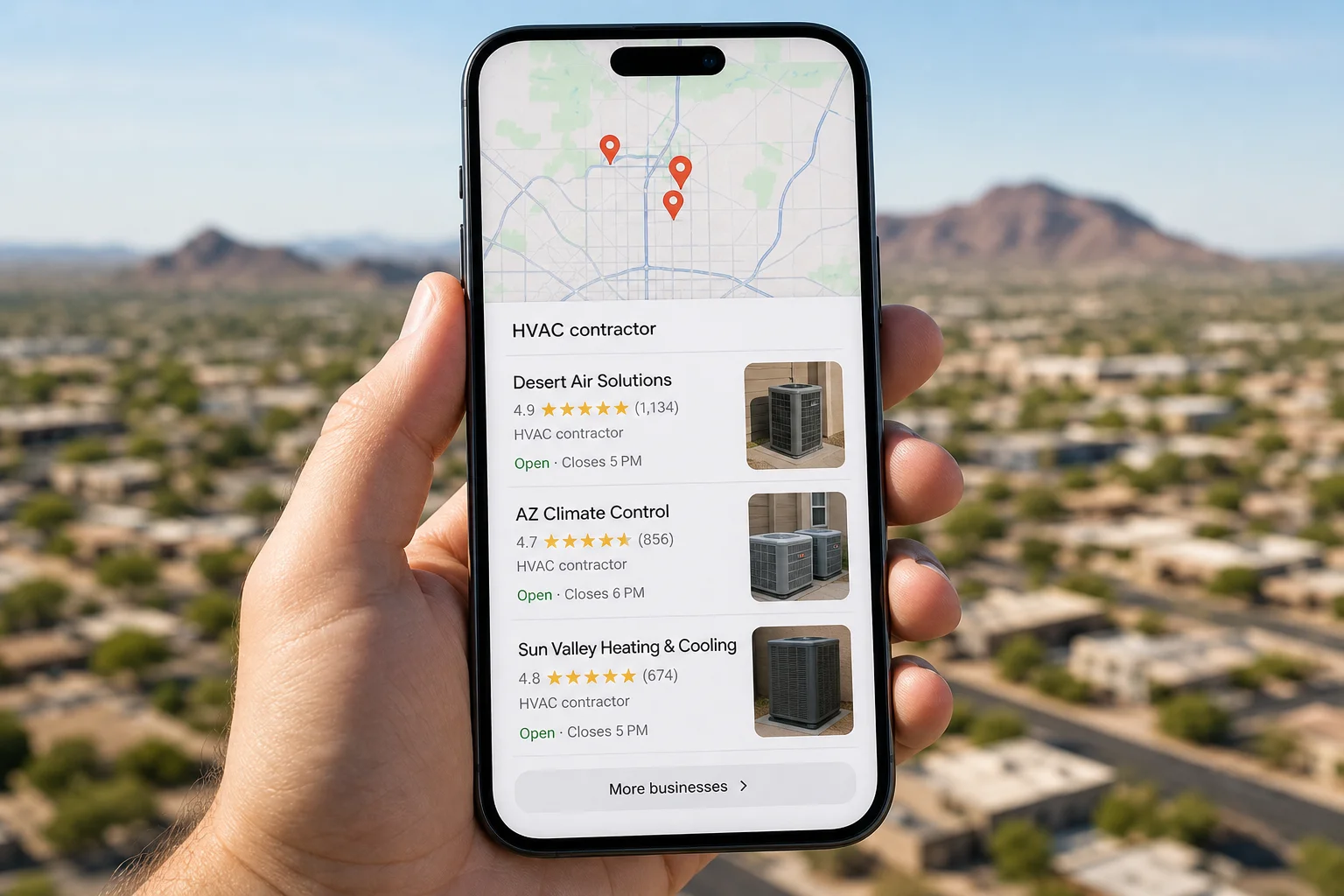
Review velocity is the rate at which you accumulate new reviews over time, not your total review count. A competitor with 200 reviews and no new ones in five months is losing ground to a business with 80 reviews adding 10 per month. Google uses recency as a freshness signal, and the map pack reflects it.
For hvac contractors in the Phoenix metro area, this matters most during the summer rush, when search volume spikes and every position in the map pack translates directly into calls and booked service appointments. The businesses at the top of the Mesa pack typically have a consistent system: an automated text message after every completed job with a direct Google review link, a QR code on the invoice, and a follow-up email two days after service. They do not wait for satisfied customers to take initiative.
The gap between competitors is not about who has the most reviews overall. It is about who is growing faster. If a competing HVAC business generates 10 new reviews per month and you generate 1, that gap compounds into a significant ranking and trust disparity within a single season. Review velocity is the lever most local businesses ignore the longest, and it is one of the clearest signals separating top-pack performers from everyone else.
Why Your Website Still Feeds Map Pack Rankings
The explanation for why a Mesa HVAC company outranks you in the map pack often traces back to the website, not just the GBP. Google uses signals from your site to inform your local seo prominence score, including page speed, mobile usability, on-page keyword relevance, and structured data markup that confirms your business name, address phone number, service hours, and geographic coverage.
HVAC companies that rank consistently in the pack almost always have a website with dedicated service area pages, fast mobile load times, and schema markup that reinforces the same information as their GBP. That on-site data feeds the prominence signal Google uses to sort the map pack.
If your top competitor has individual city pages for Mesa, Chandler, Gilbert, and Scottsdale, and your site has one generic page covering the Phoenix valley, they have stronger local relevance signals for every city-specific query in those areas. Website architecture matters here as well. Service area pages that link to each other and back to your core services send a clear signal about the geographic markets you operate in, reinforcing both local relevance and profile authority.
Local businesses that treat their website as separate from their map pack strategy are leaving ranking equity on the table. Our HVAC marketing approach addresses both the GBP and the on-site signals that most map pack audits miss entirely.
Frequently Asked Questions
How long does it take to rank higher in the map pack after fixing these issues? Most businesses see measurable movement within 60 to 90 days after addressing profile completeness, citation consistency, and review velocity. Reaching the top three in competitive markets like Mesa HVAC typically takes 4 to 6 months. The signals compound over time, so starting earlier consistently outperforms waiting for a slow season to act.
Does my business address location affect map pack rankings? Yes. Distance is one of Google's three map pack ranking factors. A business closer to the searcher has a natural proximity advantage. However, stronger relevance and prominence can offset that gap. We have seen clients rank in the top three for cities 15 to 20 miles from their registered address when their profile and website signals significantly outpaced nearby competitors.
Can a service-area HVAC business with no storefront rank in the map pack? Yes, but it requires more deliberate work. Google deprioritizes service-area businesses that hide their physical address. Using a verifiable commercial address rather than hiding your location entirely preserves the distance signal for your primary service city and improves your ability to rank for searches in those areas.
What does it take to compete on reviews in the Mesa HVAC market? Google has not published a specific threshold. Consistent observation across competitive local markets shows that review velocity matters more than raw total count. A business growing by 8 to 12 new reviews each month will typically outrank a competitor sitting at 200 total with no additions in the past 90 days.
See Where Your Map Pack Ranking Actually Stands
If a Mesa HVAC company is outranking you right now, we audit your GBP, citation footprint, review velocity, and website signals against your real competitors and do the work to close the gap. Start with a free consultation.
Want us to do this for you?
Brotherly SEO builds and runs the strategy described here for service businesses across the country.
Book a free consultation