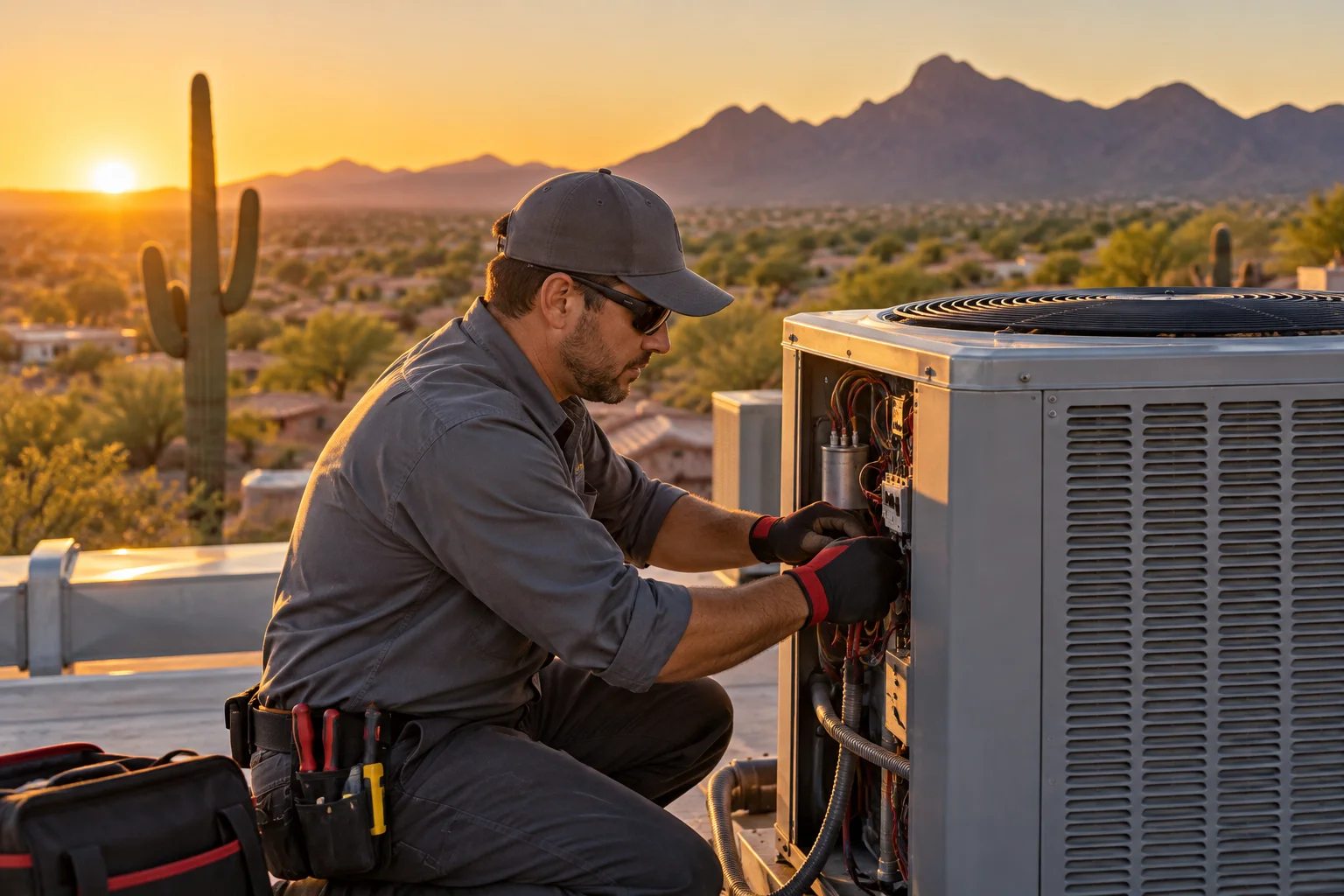
Your HVAC cost per lead in Phoenix depends on the season, the lead type, and how well your tracking works. Summer heat pushes it up, and weak follow-up wastes it. Here is what moves the number and how smart HVAC marketing brings it down.
By Christian Absher
What Drives HVAC Cost per Lead in Phoenix?
Your HVAC cost per lead is your total marketing spend divided by the number of real inquiries it produced. A real inquiry is a call you answered, a form with a working phone number, or an estimate you booked. Anything that raises spend or lowers that count pushes the number up.
Five things move it most for a Phoenix HVAC business. The table lays them out, and the paragraphs after it cover the ones owners miss.
| Driver | What pushes it up | What pulls it down |
|---|---|---|
| Season | Heat waves, when every contractor bids on the same AC searches | Spring and fall shoulder months |
| Lead source | Shared or resold leads that several companies chase | Search results you earn and customer referrals |
| Service type | Replacement and installation, with heavy competition per click | Repairs, where the homeowner needs help today |
| Call handling | Voicemail, missed calls, slow callbacks | Live answer inside a few rings, plus after-hours coverage |
| Tracking | No call or form tracking, so waste stays hidden | Every lead tied to its campaign, keyword or page |
Season gets the blame, but call handling and tracking quietly do more damage. A contractor who misses a quarter of the calls during a heat wave pays for four leads and keeps three. The ad invoice looks identical either way. Nobody sees the loss unless someone counts it.
Lead source matters because of who else the homeowner contacts. If the homeowner found you in the search results on their own, you are more likely to be the only one they call.
Service type shifts the math too, because HVAC services vary widely in value per job. Repairs move fast because the house is hot. Replacement and installation take longer and carry far more gross profit per job. A high HVAC cost per lead can be perfectly healthy for installation and a disaster for a tune-up.
Why Is HVAC Lead Cost Higher in Phoenix During Summer?
Phoenix has triple-digit heat from roughly May through September. Demand peaks in days, not weeks. When the first 110-degree stretch arrives, searches for AC repairs jump, and every HVAC company in the Valley raises its ad spend at once.
Google sells clicks in an auction. More bidders for the same searches means each click costs more, so your HVAC lead cost climbs even if your ads never change. The leads themselves are often better in July, since the homeowner needs someone today. That is why a high summer cost per lead can still produce a healthy cost per booked job.
Capacity is the other half. A crew booked out for a week gains nothing from extra leads, so many owners do better capping spend at the peaks and pushing harder in shoulder months.
What Is the Average HVAC Lead Cost in Phoenix?
I will not hand you a single average, because one number is wrong for your job. Published averages blend paid ads, resold leads and organic calls into one figure, usually without saying which season or which service they counted. A number built that way tells you very little about your own HVAC business.
What I can give you is the structure. Cost per lead differs by channel:
- Google Ads search campaigns. This is pay per click (PPC) advertising. Your cost per lead follows click price and conversion rate together, and both swing with the season.
- Local Services Ads. Google's Local Services Ads put your company at the top of the page, and you pay per lead instead of per click. Reviewing and disputing junk leads becomes part of the routine.
- SEO and the map pack. There is no per-click fee. The cost is the monthly work, spread over a growing number of calls. The number is high early and often falls as pages start to rank.
- Lead marketplaces. You pay per lead delivered, shared or exclusive.
- Referrals and repeat customers. These are the cheapest customers you will ever win, but you cannot turn them up when the phones go quiet.
What Is a Good HVAC Cost per Lead?
A good HVAC cost per lead is one your gross profit can pay for several times over. Take the average gross profit on a booked job, then think about how many leads it takes to land one. If you close one in three estimates, the price of a lead has to sit well below a third of that job's gross profit before it earns its place. Overhead takes the rest.
Repair leads and installation leads need separate targets. An AC repair call pays less per job, so it can only bear a lower lead cost. A system replacement can bear much more.
How Does HVAC Lead Generation Work for Phoenix Contractors?
HVAC lead generation is the system that turns a hot homeowner into a ringing phone. For most Phoenix contractors it runs through four pipes: paid ads, search results you earn, bought leads, and referrals. Healthy HVAC companies run more than one, because each pipe floods and dries up on its own schedule.
Paid ads switch on in a day, which makes them the fastest way in during a heat wave. Search results you own, through SEO and your Google Business Profile, take months to build. Then they keep working without a per-click fee. Referrals cost the least, but they follow your past work, not your calendar.
The type of lead changes both price and quality. This table compares the four you will meet most often.
| Lead type | Who else gets it | You pay when | Main risk |
|---|---|---|---|
| Exclusive leads | Only you, if the vendor means it | A lead is delivered | Higher price per lead, limited volume |
| Shared leads | Several companies | A lead is delivered | A race to call first, lower close rates |
| Pay per call | Depends on the vendor | A call connects and passes a minimum length | Wrong-area calls and price shoppers |
| Your own search leads | Only you | A click happens, or the month of SEO work is done | Slower to build, harder to track |
Are Exclusive HVAC Leads Worth the Higher Price?
Exclusive HVAC leads are sold to one contractor, which is why they cost more than shared ones. They are usually worth it when three things are true. You call back within minutes, you close a fair share of estimates, and the job is high value, like a system installation. In that case the higher price per lead often costs less per booked job.
They stop being worth it when nobody answers fast. An exclusive lead that waits an hour is just an expensive cold lead. Before you buy, ask three questions:
- How does the vendor define exclusive: one company per lead, or one company per trade per ZIP code?
- How do they confirm the homeowner is real?
- Do they credit bad leads, such as wrong numbers?
How Do Pay Per Call HVAC Leads Compare to Other Lead Types?
Pay per call HVAC leads charge you when a phone call connects, usually after it passes a minimum length. That suits repair work, where the homeowner wants a human voice, not a form. You skip most of the fake-form problem.
You take on a different set of problems. Some calls come from outside your service area, and some callers want a price over the phone and nothing else. Ask for call recordings and a clear way to dispute a call. Google Ads gives you more control over targeting and hours, while pay per call shifts the risk of a quiet click onto the vendor. Neither is better in every case, so judge each by cost per booked job.
Are Shared HVAC Leads Ever Worth Buying?
Yes, in narrow cases. Shared HVAC leads can fill a slow week or test a new part of town. They fail when callbacks are slow, because you are racing other companies and the first to answer often wins the job.
Cap shared leads at a small slice of spend and track them on their own line. If booked jobs do not show up within a reasonable test period, drop them.

How Much Should an HVAC Company Spend on Its Marketing Budget?
Start with a percent of revenue, not a round number. A common small business benchmark puts marketing at roughly 5 to 10 percent of revenue. HVAC companies adding a service area or building from a small base lean toward the higher end. Companies with full schedules and steady maintenance customers sit near the lower end.
Your HVAC marketing budget should also be split by time horizon. Some of it produces calls this month: paid ads, Local Services Ads and call tracking. The rest produces calls next year: SEO, a page for each service and city, review requests and your Google Business Profile. A budget made only of paid ads rents your pipeline. A budget made only of SEO starves you through the slow months.
Here is what a budget typically funds:
- Ad spend on campaigns that run in the weeks you can serve the demand
- Tracking setup, so every call and form ties back to its source
- The pages and listings that earn search results
- Someone who handles optimization month to month and reports honestly
It does not buy a guaranteed number of leads, and no honest agency will promise one. Marketing strategies work when the budget matches your crew size and job mix.
How Can an HVAC Company Lower Its Cost per Lead?
Lower costs come from fixing the leaks before you buy more water. This is the order we would work in for an HVAC business:
- Count every call and form. Tracking setup comes first. Many HVAC contractors run campaigns for months without knowing which one produced the booked jobs. Until you know, every cut is a guess.
- Match spend to intent. A homeowner searching for emergency AC repairs has different intent than one researching a replacement. Trim searches that bring clicks but no calls.
- Answer the phone. Missed calls inflate cost per lead faster than any bid change. After-hours coverage in July tends to recover leads you already paid for.
- Build a page for each job. A page written for AC repair in one city usually converts better than a general homepage.
- Earn search results. SEO and your Google Business Profile reduce your reliance on paid ads over the year.
- Shift budget with the calendar. Lean in during shoulder months. Hold back at the peaks when crews are already full.
If your paid ads are the expensive part, our Google Ads management starts by splitting your cost per lead by campaign and by call, so you see what to fix first.
The same logic holds in other industries and other ad accounts: find the waste first, then fix it.
How Long Does It Take to Lower HVAC Cost per Lead?
Paid fixes show up first. Tracking and campaign cleanups often change the picture within the first few weeks, though you need enough calls to read a real trend. Judge results against the same season, not last month: compare July to last July.
SEO takes longer. New pages usually need several months to rank, and competitive Phoenix searches can take longer. Rankings depend on your market and your competitors, so we frame them as movement achieved during an engagement, never as a promise.
HVAC Lead Costs: Your Questions Answered
How do I calculate cost per lead for my HVAC business?
Add everything you spent on a channel in a month: ad spend, vendor or agency fees, and call tracking. Divide by the number of real leads that channel produced, meaning answered calls and usable forms, not raw clicks. Do it per channel and per service type.
How do I calculate my true cost per customer?
Take the same total spend and divide it by new customers who paid you, not by leads. This number includes your close rate, so it is the honest one. If your cost per lead looks fine but your cost per customer is high, the problem is usually follow-up speed or estimate quality.
Is Google Ads or SEO cheaper per HVAC lead?
Neither wins in every case. Google Ads brings calls within days, but you pay for every click and the price rises at the summer peaks. SEO takes months to build, then spreads its cost over a growing number of calls. Most Phoenix contractors do best running both, with paid ads covering the gaps while search results grow.
Why does my cost per lead look low while few jobs get booked?
Usually the leads are poor, not cheap. Wrong-area calls, price shoppers and form spam all count as leads on a report. Track booked jobs by source, listen to call recordings, and judge each channel on cost per booked job instead of cost per lead.
Find Out What Your HVAC Leads Really Cost
Tell us what you spend today and how many of those calls turn into jobs, and we will show you where the cost is hiding and what we would change first. Start with a free SEO consultation.
Want us to do this for you?
Brotherly SEO builds and runs the strategy described here for service businesses across the country.
Book a free consultation